




AI is no longer a question of if – it has become what we might call a strategic non-decision. The impact is inevitable: lower costs, higher quality, better compliance and entirely new services. The real question is how AI will fundamentally reshape your business – and how you choose to respond.
At Valcon’s World of Data and AI in Copenhagen event, we explored how organisations can move from early experimentation to real value creation.
In part one, we outlined the three maturity levels of AI and why progress is ultimately driven by leadership decisions – not technology alone.
In this second part, we focus on what leaders must decide and get right to turn ambition into value – from building the right foundation to staying in control and making deliberate strategic choices.
Building the foundation for AI at scale
To move beyond pilots, AI requires a clear and connected foundation. At its core is a simple three-layer stack:
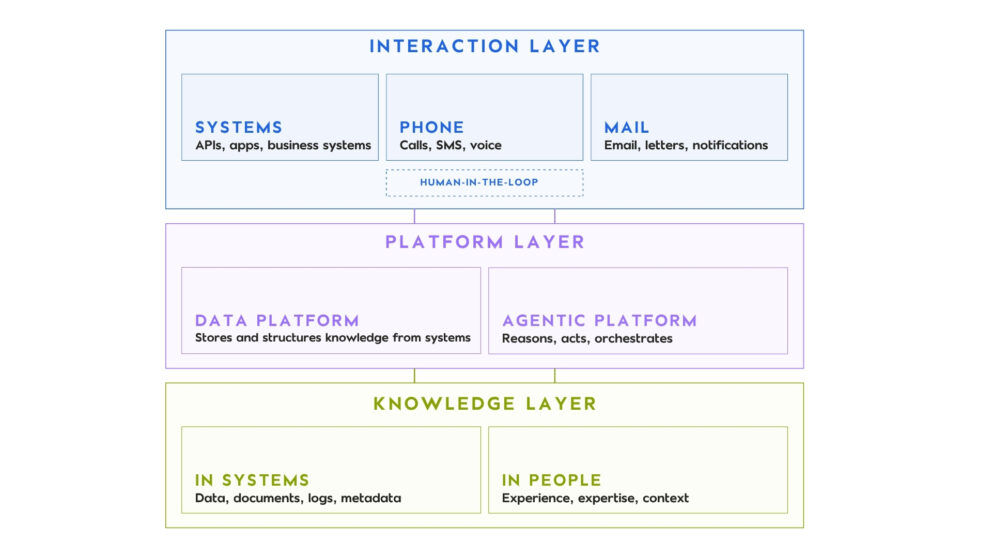
- A knowledge layer, consisting of data, documents, logs and – equally important – human expertise and context
- A platform layer, including both a data platform and an agentic platform that can reason, act and orchestrate
- An interaction layer, where AI connects to systems, applications and communication channels – always with humans in the loop where judgement is required
Without this stack, more investment simply leads to more isolated pilots, not transformation.
From copilots to agents: orchestrating work
Once this foundation is in place, the role of AI fundamentally changes. AI moves from supporting individuals to agents performing work across systems and processes. But this only creates value if it is managed deliberately.
These agents must be orchestrated in the same way organisations manage people, which requires a shift in how teams collaborate with technology:
- Goals must be broken down into executable tasks
- Roles should be specialised, not generalised
- Workflows must coordinate activities across systems
- Context must be shared through a common knowledge base
- Governance must ensure traceability, control and escalation
- Learning must continuously improve outcomes
Without orchestration, mistakes happen – but at machine speed. With the right orchestration, AI becomes a reliable, scalable workforce.
Control, accountability and the role of leadership
A common misconception is that AI removes the need for human decision-making. In reality, it increases the need for clear accountability. AI can provide the foundation for better decisions – but it should never replace decision ownership.
Someone must always be accountable for the outcome. At the same time, organisations must ensure that their AI systems are controllable. This requires clear guidelines, monitoring mechanisms and governance structures, often supported by AI itself.
Ultimately, the question is not whether AI can act, but how you stay in control when it does.
This is where leadership becomes critical. AI transformation is not a technology initiative, but a strategic and organisational shift owned by the executive team.
To move from ambition to real value creation, leaders must ultimately take a position on how AI will shape their organisation.
Choosing your strategic position: lead, follow or co-op
Once the foundation is in place and control is established, the key question becomes clear: how do you want to compete with AI?
Organisations typically have three options:
- Lead – build in-house and own the IP when AI is core to your competitive advantage
- Follow – move with the ecosystem and differentiate through execution, making AI more of a cost factor than a differentiator
- Co-op – build together with a partner who can scale and operate the solution. Often, the fastest way to create impact without full ownership
The critical point is simple: do not default into “follow” by accident. Choose deliberately.
Conclusion
Humans fail, but machines fail faster.
Which is exactly why leadership, governance and deliberate choices matter more than ever – and why the organisations that act now will define the next generation of winners.
Moving from ambition to value is not about adopting more AI, but about making the right decisions on how it is applied, governed and embedded into the business.
Reach out
If you would like to continue the conversation or explore how these ideas apply to your organisation, feel free to reach out. And if you are interested in participating in next year’s World of Data & AI on 12 May 2027, we would be happy to hear from you.
Contact

Managing Partner and Consulting Lead
Thomas Rosenlund
+45 2049 5427

Partner and Data Lead
Morten Ib Ingstrup
+45 2246 5473

Partner and Head of AI
Koko Visser
+31 623609586