



AI is no longer a question of if; it has become what we might call a strategic non-decision. The impact is inevitable: lower costs, higher quality, better compliance and entirely new services. The real question is not whether to adopt AI, but how it will fundamentally reshape your business – and how you choose to respond.
This question, among others, was addressed at Valcon’s World of Data and AI Copenhagen event. Bringing together senior leaders from across industry and the public sector to explore real-world implementations of data and AI, the event delivered on its promise to focus on actionable lessons and real outcomes rather than on theory and hype.
To kick off the event, three experts from Valcon shared their insights into the three phases of AI transformation and the decisions to unlock them. In this 2-part blog series, we will share these insights.
AI is the next enterprise revolution
If we look back, every major technological leap – steam, electricity, computing, networks – has fundamentally transformed how organisations operate. AI represents the next wave in this evolution. But as with previous revolutions, real value does not come from the technology itself. It comes from profound business transformation driven by leadership and shaped by organisational culture.
Organisations that move beyond the hype and are willing to rethink how they operate will be the ones that win. And in the opposite case, perhaps they will lose.
The three levels of AI maturity
To understand this transformation, it helps to look at AI maturity across three levels.
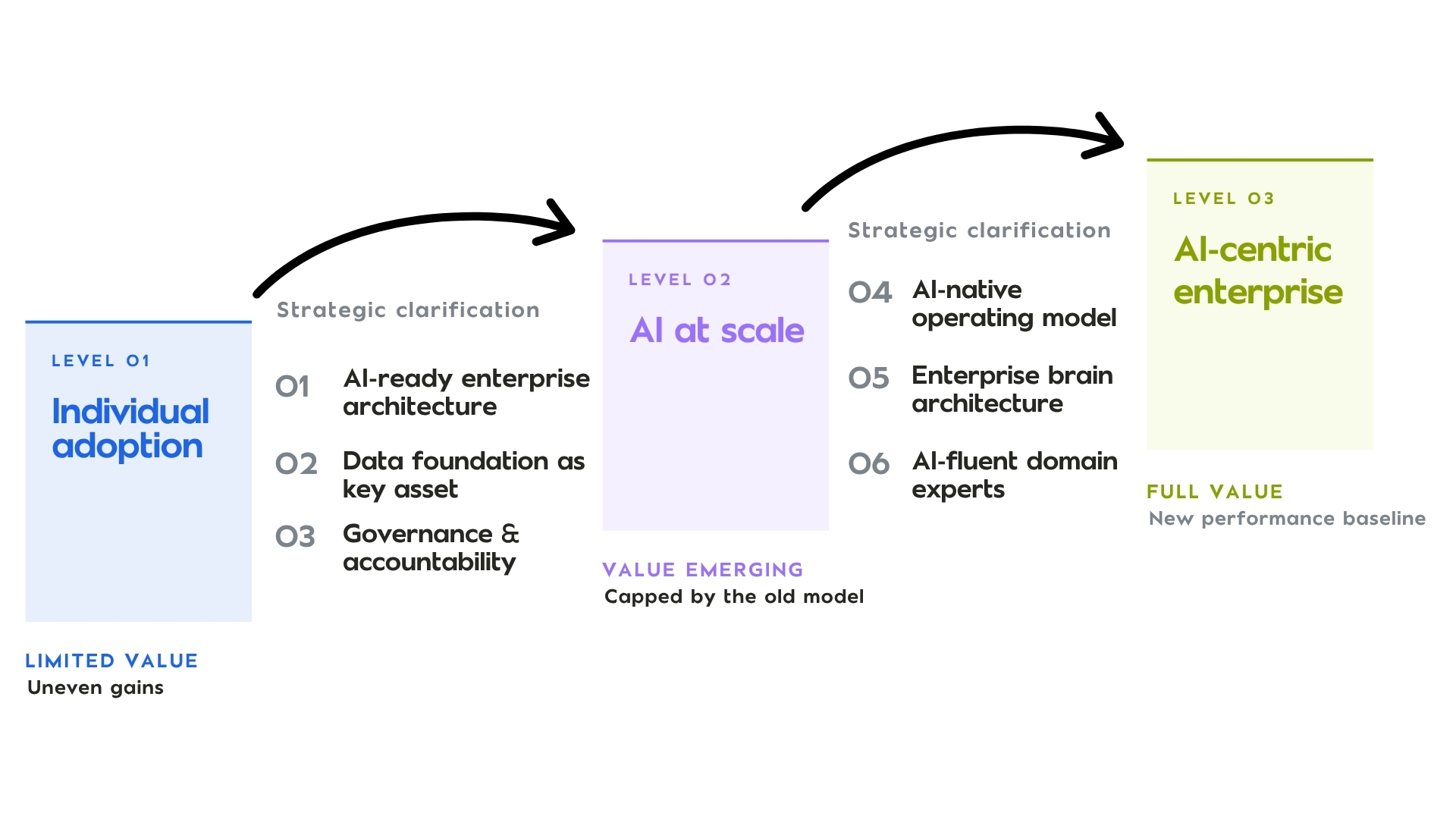
- Level 1: Individual adoption, also known as pilot purgatory. This is where most organisations today find themselves. Here, AI is used by enthusiastic individuals, productivity gains are real but local, and the operating model remains unchanged. There is activity – but limited business impact.
- Level 2: AI at scale, where value starts to become visible. AI is embedded in end-to-end processes, supported by a stronger data foundation and architecture. However, value is still constrained by legacy ways of working.
- Level 3: The AI-centric enterprise. AI becomes central to how work is executed, decisions are made, and value is created. Humans shift focus towards direction, ethics and relationships, while AI agents orchestrate execution – and the culture shifts from adapting to working natively with AI.
What it takes to move from pilots to real value
Progressing from one level to the next – and moving from ambition to value – is not a function of time or spend. It is a function of strategic leadership decisions.
The shift from AI maturity Level 1 to Level 2 requires a conscious decision at the leadership level to invest in core capabilities across architecture, data and governance.
1. Your architecture must be connected. AI cannot work in silos – it needs access across systems, with a data platform at the core. Otherwise, you simply create more pilots.
2. AI requires clean, structured data that can be used without continuous human correction. If data quality is poor, AI will not just fail — it will fail systematically and at scale. The question is no longer whether we can work around bad data, but whether we are willing to fix it.
3. You need clear rules and ownership. As AI takes on more work, mistakes move from being individual to systemic. That means putting guardrails in place – from policies and regulations to human-in-the-loop checks – and being clear about who is accountable for both risk and results.
Moving from AI maturity Level 2 to Level 3 requires rethinking how the organisation operates. This means designing work with AI in mind from the start, rather than adding it on top of existing processes.
4. You must have an AI-native operating model in place where work is redesigned from the ground up with AI and agents, which may look quite different from the existing processes.
5. Organisations must evolve from a data platform to an enterprise “brain” architecture – a shared decision system that brings together strategy, KPIs, policies, memory and decision logic. This enables AI not just to inform decisions, but to participate in them.
6. Success depends on AI-fluent domain experts. Business leaders must become comfortable operating and designing with AI, effectively bridging the gap between business and technology – and helping shape a culture where AI is actively used, challenged and improved.
This is where AI transformation really happens – not in the tools, but in how the organisation thinks and works with AI.
Conclusion
AI will not just optimise existing ways of working – it will redefine them. Those who treat AI as a set of tools will see incremental gains, while those who treat it as a driver of business transformation will unlock entirely new levels of value.
But understanding the transformation is only the first step. The next question is: what decisions do you need to take to move forward? Not just in technology, but in how your organisation works and thinks?
In part two, we move from understanding the journey to making key strategic choices – from deciding your position in the market to building the architecture and operating model that enables AI at scale.
Reach out
If you would like to continue the conversation or explore how these ideas apply to your organisation, feel free to reach out. And if you are interested in participating in next year’s World of Data & AI on 12 May 2027, we would be happy to hear from you.
Contact

Managing Partner and Consulting Lead
Thomas Rosenlund
+45 2049 5427

Partner and Data Lead
Morten Ib Ingstrup
+45 2246 5473

Partner and Head of AI
Koko Visser
+31 623609586