







Today’s airports face a perfect storm. Geopolitical uncertainty, climate regulations and workforce shortages mean operations are getting squeezed from all sides. Meanwhile, customers now expect seamless, affordable experiences. This puts airports at a crossroads. To survive and thrive, they need to innovate processes and enable AI-driven automation, all while keeping safety at the top of the priority list. There’s no other way forward.
What will autonomous airports look like?
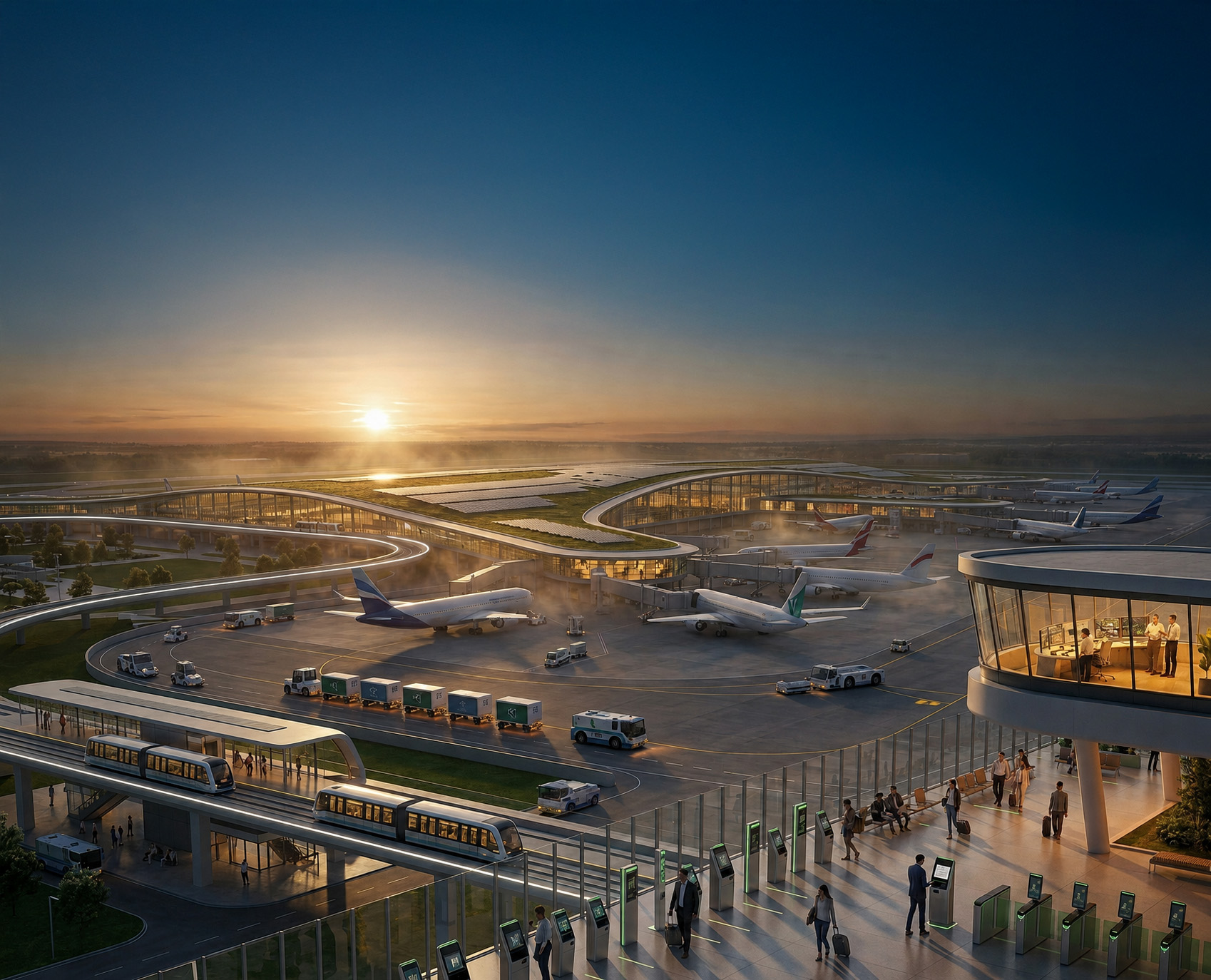
Fast forward 24 years to 2050. The top airports have evolved into semi-autonomous, data-driven mobility hubs. They are no longer run by collections of loosely coupled systems, but by deeply integrated ecosystems in which data, processes and people work seamlessly together to smooth airside and landside operations.
Disruptions to air travel are anticipated and prepared for rather than managed reactively once they happen. Predictive models continuously assess congestion risks and enable proactive reallocation of resources before the bottlenecks arise. When delays or capacity constraints are identified, the impact across the entire operation will be assessed immediately.
Intelligent systems trigger adjustments to operations, from arrival sequencing to gate and baggage allocation. Travellers receive timely, personalised guidance that adapts and updates in real time to the changing conditions. Meanwhile, on the airside, repetitive activities will be largely automated and electrified, all supported by autonomous vehicles and robotic systems. Human expertise will remain critical, but the focus of operational staff starts to shift towards oversight and intervening in situations when human judgment is necessary.
Importantly, the airport no longer ends at the terminal doors in 2050. Flights, public transport and parking operate as one connected transport network, which is coordinated through shared data and demand forecasts. For passengers, the journey will feel seamless, because decisions are made coherently across the boundaries of all the organisations that are involved.
The result is an airport that operates faster, greener, safer and is more resilient, capable of handling much higher passenger demand with fewer resources. And less disruption.
Where are we standing today?
This future vision is ambitious, but it’s not completely science fiction. It could be within reach, and many of the building blocks already exist. Some of the world’s leading airports are already embracing technological innovations. Take Schiphol in Amsterdam, which has started testing automated electric vehicles for baggage and cargo transport on the airside. Singapore Changi Airport has a trolley management system that automates the collection, redistribution and availability of baggage trolleys – this helps to improve the passenger experience and optimise operational resources. Munich Airport has a system called the Digital Testbed Air Cargo (DTAC) that applies AI and real-time analytics to forecast bottlenecks in cargo handling operations – this helps enable proactive resource allocation before delays build.
And airports around the world are implementing autonomous border control gates with biometric identity verification and risk-based screening. All of these solutions are valuable, but they tend to optimise a single process or domain. As a result, they only deliver isolated efficiencies but can’t really tie together all the operations across the airport. What is still missing is the ability to connect these solutions into end-to-end operational decision-making.
Five steps to achieving the autonomous airport vision
To fully reap the benefits of data- and AI-driven technologies so we can create this airport 2050 vision, they have to be implemented in the core of day-to-day processes and decision-making. To achieve this, airports need to do the following five things:
- Combine tools in automated flows: it’s important to integrate digital solutions into end-to-end workflows where data-driven insights automatically trigger coordinated actions. For example, at multiple airports, BagsID automates identification and tracking of baggage pieces with computer vision. Additionally, SICK’s BagSense system automatically detects baggage that isn’t the right size, filters it from the main conveyor system and routes it for manual handling by ground staff. This stops system disruptions from happening.
Build a sustainable data infrastructure: airports need a modern data backbone that is open, scalable and resilient. Open architecture prevents silos and enables new systems to be seamlessly integrated. Scalable platforms process operational data instantly and are able to scale during peaks. And data resilience ensures operations continue under stress. Leading airports are already making steps in this direction. Heathrow Airport’s data platform integrates operational data streams from across the airport ecosystem to form a backbone for end-to-end automation.
Connect the partner ecosystem: true airport orchestration requires interoperability across airlines, air traffic control, border agencies and surface transport. Amsterdam Airport Schiphol and Singapore Changi do this through coordinated operations control and real-time data sharing with local public transport partners. And you can improve these models through data sharing to ensure partners can respond more effectively to disruptions.
Embed security & compliance: as operations become autonomous and AI-driven, security and compliance must be built in from day one. It’s important to establish clear data governance frameworks defining ownership, access and retention. The same with robust cybersecurity protection – and human oversight will mitigate risks of bias, intransparency and error in automated decision-making.
Develop a data-driven workforce: employees need training, data literacy and a safe environment to experiment with automation. Investing in upskilling programs that combine operational expertise with digital capabilities will make staff feel empowered by new tools, not replaced.
The good news? You don’t have to do everything at once. The autonomous airport of 2050 begins with decisions made today. Build your data foundation incrementally, establish data-sharing agreements with key partners early and invest in data literacy programs for your workforce. Focus on quick wins that demonstrate ROI and build confidence. These might seem like baby steps, but together will help you achieve your airport 2050 vision.
Not sure where to start? At Valcon, we partner with airports to navigate this transformation, from strategy to implementation. Feel free to reach out to Steven van der Kruk (Head of Aviation), Jasper van Ooijen (Aviation Data & AI lead) or Luuk van Maasakkers (Data & AI Expert) to explore your next steps.