


Retail store innovation has never moved more rapidly. Developments in AI, computer vision, RFID, smart checkouts and connected store platforms are redefining what a physical store can and should be, and retailers are feeling the pressure to keep up.
But for retailers, the more important question is not “how much innovation can we put into retail stores?” – it is which innovation actually makes the store work better for customers and employees.
That distinction matters. Retail outlets are dealing with lots of different challenges, from staff shortages and inventory issues to increasingly complex omnichannel operations and higher customer expectations. At the same time, stores are becoming digital operational hubs rather than simply physical points of sale as they once were. This makes the store one of the most important places to innovate: it is where customers, employees, inventory and cash come together every day.
So what does an innovative, intelligent store actually look like? Which innovations deliver?
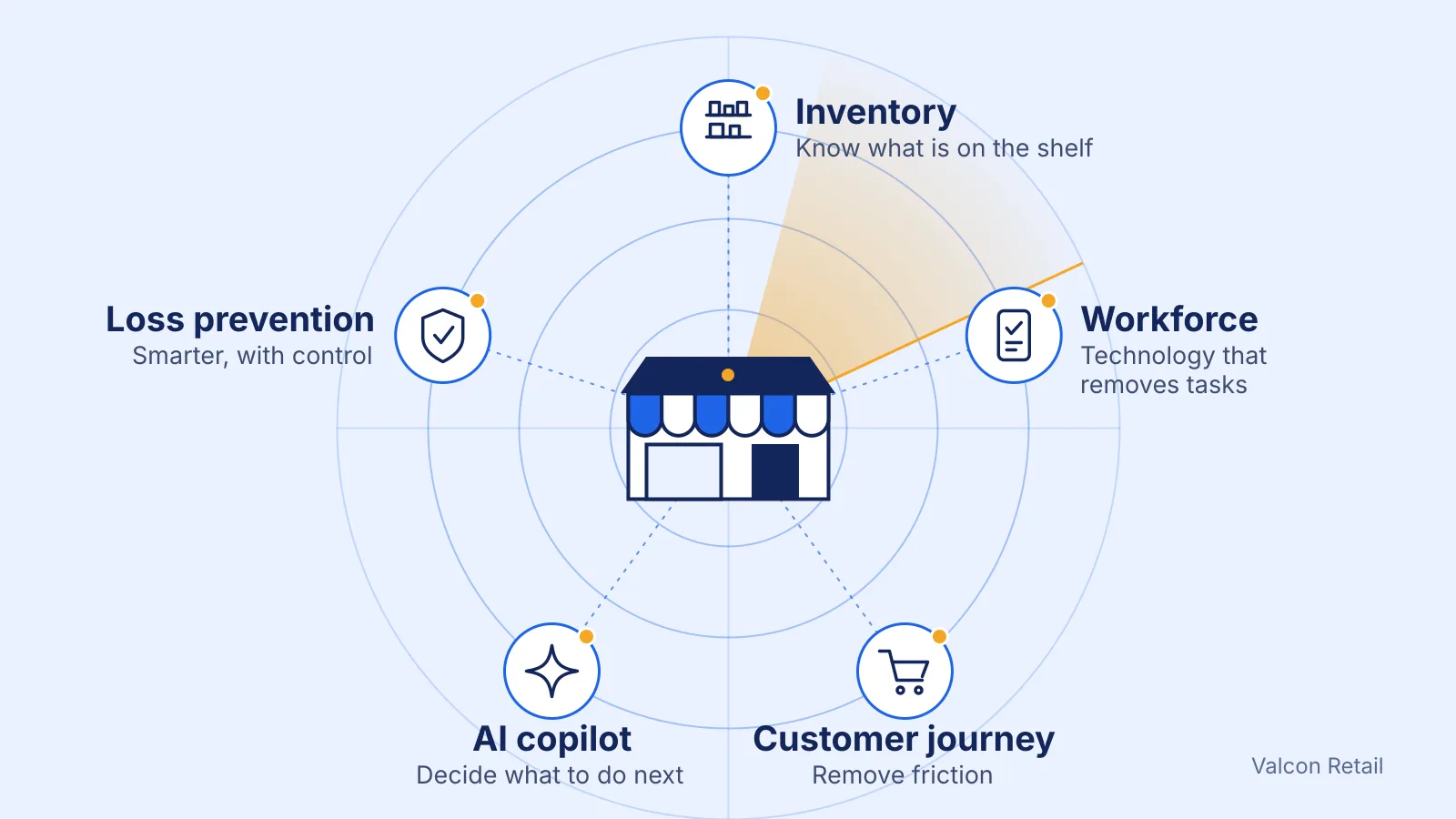
1. Innovate the shelf: know what is really there
A retailer might have excellent demand forecasting, but it means little if the system thinks an item is in stock while the shelf is empty.
Intelligent inventory combines RFID, computer vision, demand forecasting and shelf intelligence to improve stock accuracy and availability. The innovation is not the sensor or the camera; it is a shop that continuously knows what it has in stock and where that stock is. Better visibility can reduce the incidence of ‘out-of-stocks’ and create a stronger foundation for replenishment, ‘click & collect’ and store execution, which is important in an era where customer satisfaction and loyalty are key.
2. Innovate the work: technology that removes tasks
In a retail environment where labour shortages are common, the answer is not to ask employees to work faster and longer hours than they might be already. Store innovation should remove unnecessary tasks that retail employees have to do and make the remaining work easier.
Connected workforce solutions bring workforce management, task management, knowledge and mobile store operations together, helping employees to understand what needs to happen, when and why. The most valuable innovations are the ones employees actually want to use because they make their day easier and make them more productive.
3. Innovate the customer journey: remove friction
Nobody visits a store because they enjoy standing in a queue. Innovations like ‘Scan & Go’, self-checkout, smart carts and autonomous checkout can make payment faster and more convenient while addressing operational costs at the same time. But frictionless commerce should not be innovation for innovation’s sake. A faster checkout experience only creates value when it works for customers and store operations and when the shop is redesigned around it rather than having the technology bolted on.
4. Innovate the decisions: turn AI into an operational colleague
Perhaps the biggest retail store innovation comes when shops move from dashboards that describe yesterday to technology that helps employees decide what to do next.
A store manager copilot could surface exceptions and priorities, for example. Forecasting and replenishment agents could identify where action is needed. Retail knowledge assistants could make operational knowledge available at the time when an employee needs it. That is where AI becomes less of an experiment and more of an operational capability.
5. Innovate with control: smarter stores, lower risk
More intelligence should also mean better control. Computer vision, security analytics and smart-camera platforms can help to prevent shoplifting, improve fraud detection and increase store safety, so that innovation helps to protect margin instead of putting it at risk.
Make store innovation a repeatable capability
The common thread across these five areas of innovation is the creation of measurable business value. Innovation for retail stores should ultimately contribute to one or more of four outcomes: revenue, cost, risk or customer experience, whether through fewer out-of-stocks, higher productivity and more switched-on staff, or shorter queues.
Many retailers can run an impressive pilot in a flagship or test store. Far fewer manage to turn it into results across a chain of shops. The difference is rarely the technology; it is how that innovation is managed.
Innovation is not the destination
The store of the future will not be defined by how many technologies a retailer deploys. It will be about how intelligently those innovations work together across customers, employees and store operations. That requires retailers to start with the operational problem, select the capabilities that can solve it and measure whether the value is actually being created. It shouldn’t be about technology for technology’s sake – it has to have a positive impact.
Perhaps the question isn’t “What does the store of the future look like?” anymore. It’s: “Which store innovation should we try out first?”
Get in touch
Want to explore where store innovation could create measurable value in your organisation? Get in touch with Michel van Zelst at [email protected] (Valcon Retail Sector) to discuss where to start.