




Ask a pharma supply organisation how long it takes to make a batch, and you will get a precise answer. Ask how long it takes to turn a demand shift into a revised show-floor plan, and most cannot say. That second clock is rarely measured, yet it is where most of the time is lost.
I The problem: three delays between a signal and a patient
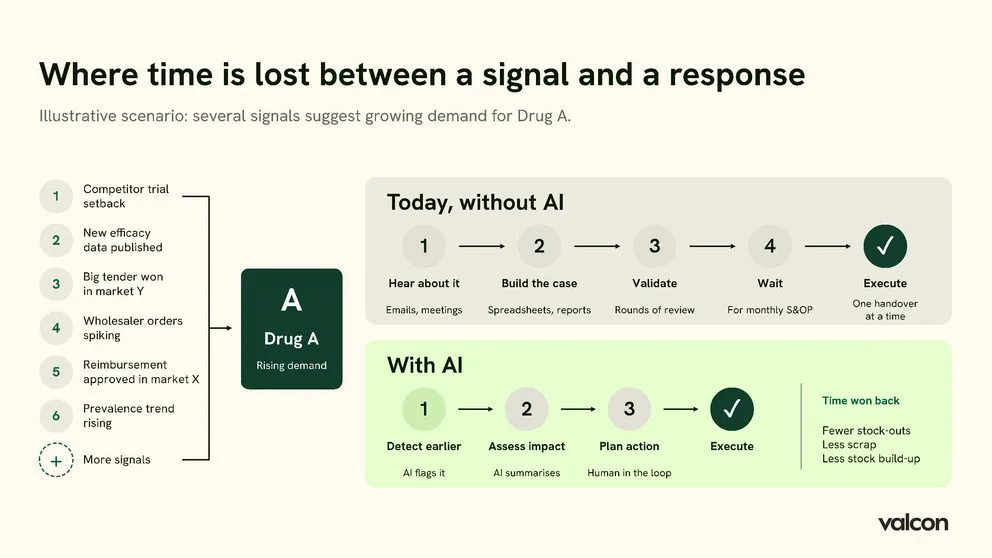
- Sensing delay is the gap between a signal appearing and someone seeing it. Process drift sits unnoticed in production data, and a tender result sits in someone’s inbox.
- Decision delay is the gap between seeing a signal and acting on it. A deviation waits for investigation, and a demand shift waits for the next monthly planning cycle.
- Execution delay is the gap between a decision and product moving. The batch waits for release, and packs and registrations tie stock to a fixed market.
In pharma, each of these delays is longer than in most industries. Safety stock must cover release lead time as well as demand; a deviation can hold a batch for weeks, and markets require a minimum remaining shelf life at delivery.
A deviation is often just a signal that arrived too late.
II The complication: AI pilots speed up steps, not the flow
Most AI initiatives in manufacturing and supply speed up one step: a faster review, a sharper forecast, and earlier fault detection. They rarely address delays between steps, which is why even successful AI pilots often leave lead time unchanged.
The signals that matter most are also the hardest to use. Operational signals such as batch status and orders are structured, but tactical and strategic ones, such as competitor launches, tenders or upcoming regulatory changes, arrive as emails and slide decks. Generative AI adds most value by turning these sources into usable planner inputs. In operational execution, the gains come from agents and automation.
III The solution: three levers for an AI-enabled supply chain
- Capture signals with their constraints. Start from the decisions that lose value through delay, then identify the signals that trigger them. Capture each signal with the constraints that limit the response: a tender win means less if the contract caps volume. Keep them in a signal library, where every signal has an owner, a decision it feeds and a threshold for action. Then reduce the constraints that block action most often, for example through late-stage packaging postponement.
- Move from planning cycles to planning triggers, with thresholds. Monthly S&OP cannot respond to a signal that arrives on day three, but reacting to every signal makes plans unstable and undermines trust. Use signal library thresholds to decide which signals justify an off-cycle decision, who owns it and what AI agents may change on their own. Event-driven planning is an operating model change before it is a technology change.
- Let one decision reach every function at once. An off-cycle decision only saves time if revised plans reach suppliers, manufacturing, quality, regulatory affairs and commercial simultaneously, not one hand-over at a time. Quality is often where that cascade stalls, so design release for exception: the value is in no longer reviewing what is not needed. Human oversight and verified outputs for critical decisions are a must, whatever the final EU GMP Annex 22 says.
IV The value: more than just speed
Pull these three levers, and the payoff shows up across the business. The first thing you notice is speed. The bigger wins are sales protected from stock-outs, batches saved from scrapping, stock shipped before expiry and planners freed from fixing data. More predictable batch release also reduces safety stock, which frees up working capital.
V A prerequisite: make the planning system you have work
We see planners spend much of their time correcting data and building Excel workarounds for hard-to-use systems. AI can help here first, by correcting data at the source and guiding planners through the system they already have.
VI What it takes on the technology side
Built on reliable source data and usable planning systems, the solution links specialised algorithms, each feeding the next, from signal extraction through impact modelling to supply optimisation. This modular architecture allows each task to use the most suitable method, with performance, validation and controls tailored to its intended use.
Signal detection combines structured feeds with information extracted from emails, publications and regulatory homepages, announcements, using rules or AI models suited to each source. These inputs are standardised into event records describing what happened, the products and markets concerned, relevant timing and supporting evidence, with extraction confidence and event credibility assessed separately before impact assessment.
Impact assessment could separate market effects from supply implications, first translating signals into demand scenarios with explicit assumptions and uncertainty. These scenarios would feed a supply-network model linking materials, manufacturing, packaging, quality release and markets, using existing planning knowledge and live inventory, capacity and batch-status data. Simulation would test responses’ effects on delivery, bottlenecks and other products, while constrained optimisation would identify feasible combinations of changes against agreed objectives. Planners would receive specific recommendations with their dependencies, trade-offs and underlying assumptions visible.
A shared decision and orchestration layer would record the approved plan and distribute function-specific inputs and actions through existing systems with ownership, dependencies and progress tracked centrally. Independent activities could run in parallel, while dependent activities would remain subject to their prerequisites and required approvals. This would reduce coordination delays without bypassing batch testing, quality review or release requirements.
VII What to do first: measure the delays
None of this has to be built at once. Most pharma companies already have some of the pieces: a forecasting model in one market, a document review tool at one site. What is missing is the connection between them, from sensing a change in demand to adjusting the plan and releasing the product. There is no ready-made use case for that, so the next step is not another pilot. It is to start with the flow.
This is how you get started: a signal-to-patient diagnostic. Take one product family and a recent supply event, such as a stock-out or a write-off. Trace when the first signals appeared, when they reached a decision-maker, when action was taken and where the days were lost. Then quantify which interventions would shorten the sensing, decision or execution delay, and which of your existing pilots could be connected to deliver them.
VIII Conclusion: the world can tell you how to get products faster to patients. Is your supply chain listening?
External signal data has never been more available. Real-world and prescription data, trial registries, regulatory databases, epidemiological statistics, and trade and logistics data are all public or licensable. Access to relevant data is not the constraint.
The constraint is linking signals to your systems and organisation. A competitor launch in one country only becomes actionable if your master data connects it to the products, packs and batches at risk. Without that link, the signal stays an anecdote.
Acting on signals also takes a world perspective. Many pharma supply chains are still planned by site or by region, while signals cross borders faster than plans do. One view of demand, supply and inventory across markets lets a signal in one market trigger a response in another. Those signals must also be trusted, with clear provenance, licensing and compliance with health data rules, such as GDPR in Europe and HIPAA in the United States.
Our view: do not build a data lake of everything. Build a curated signal library linked to decisions. Then power it with AI.
Contact

Associate Partner | Consulting
Jesper Bo Jensen

Manager | Consulting
Prajakta Dengale

Partner | Consulting
Martin Birger Hjørland

Partner | Data
Morten Ib Ingstrup