

Most supply chain teams have started using AI. Far fewer have changed how a function works because of it. Here is why the first does not lead to the second on its own, and the process we use with leadership teams to get from one to the other.
Where bootstrapping stops
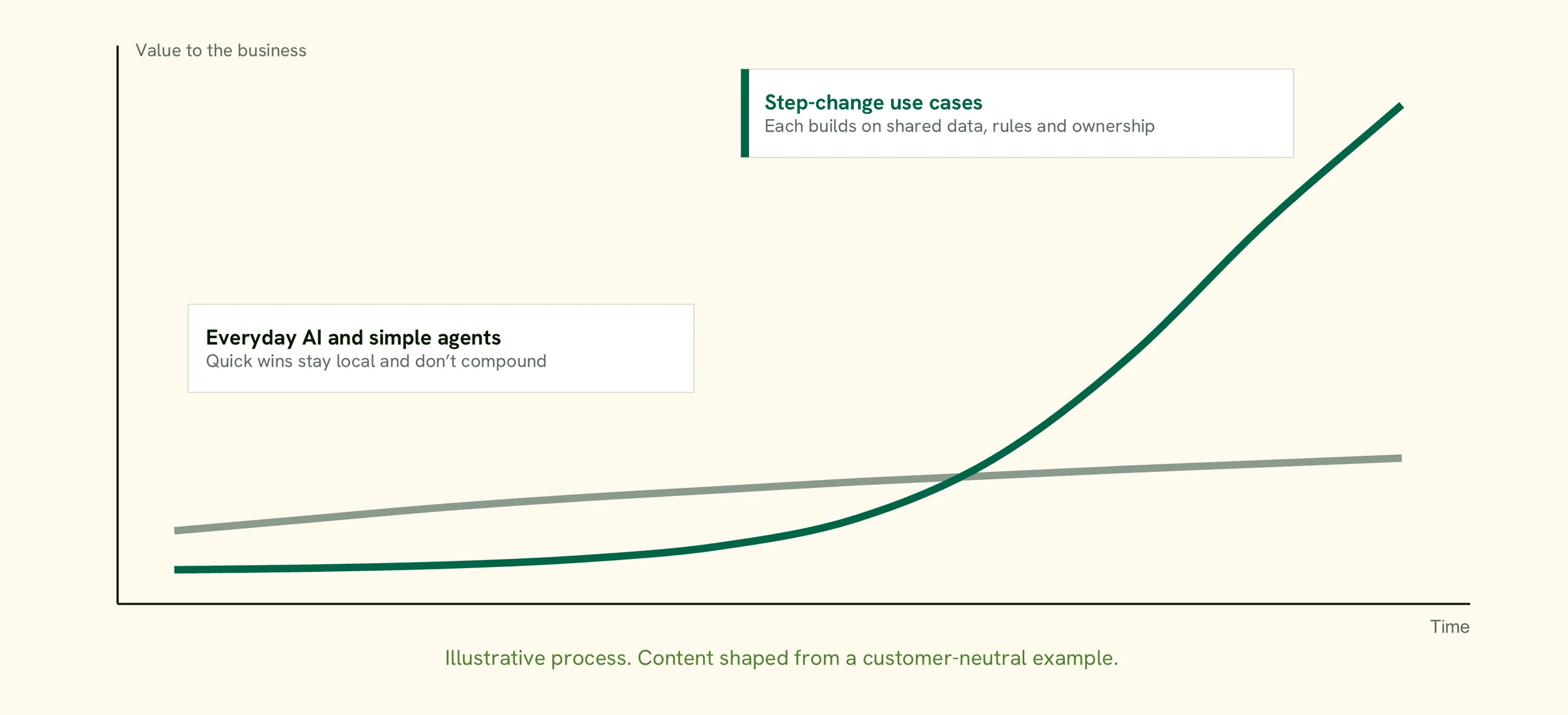
Most organisations start the same way. They roll out a copilot, build a few simple agents and make data easier to reach. People fix their email faster, summarise documents in seconds and find the number they need without asking three colleagues. It works, and it should. This is the low-hanging fruit, and it builds familiarity.
Then leadership asks a harder question: what does all of this add up to, and where does the real value-creation take place? Bootstrapping struggles to answer it. Each gain is local and personal. There is no shared foundation to build on, no owner for the outcome, and no way for ten small wins to become one big one. It does not compound, and it does not scale.
Two kinds of AI use cases
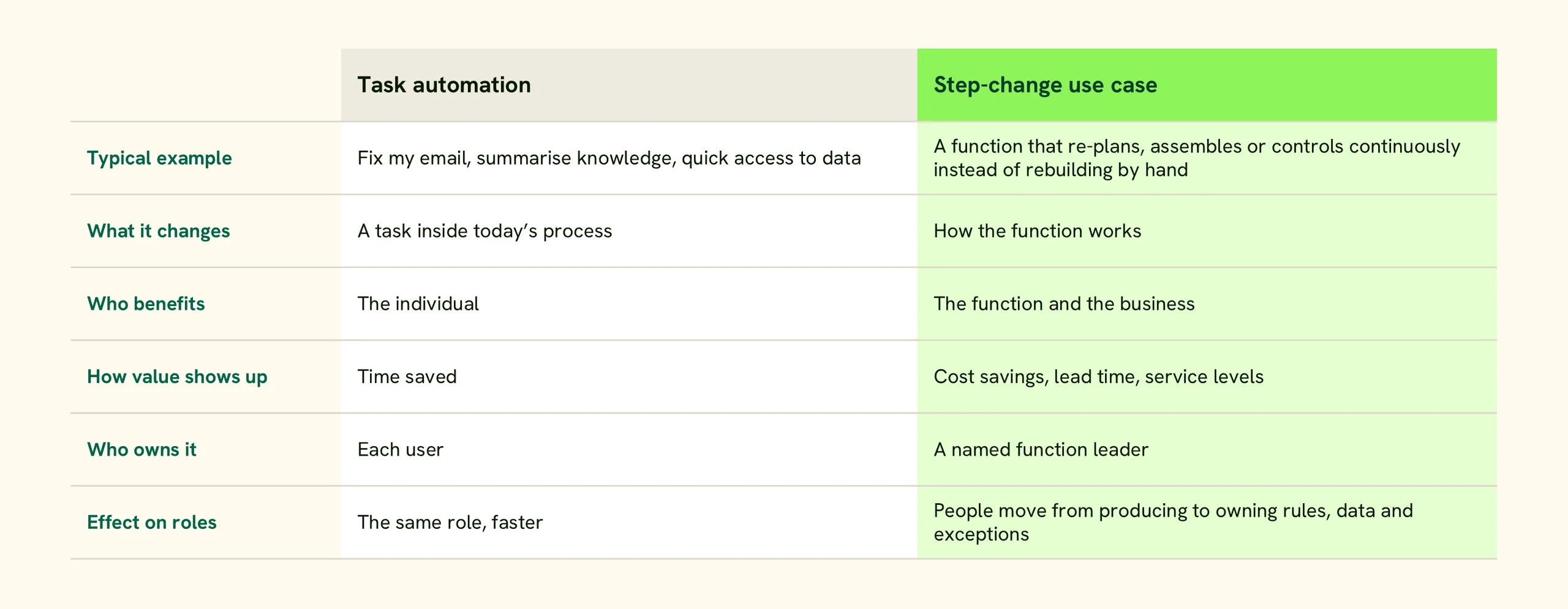
The distinction we use is simple. The first kind speeds up a task. The second changes how a function works.
From hours to value
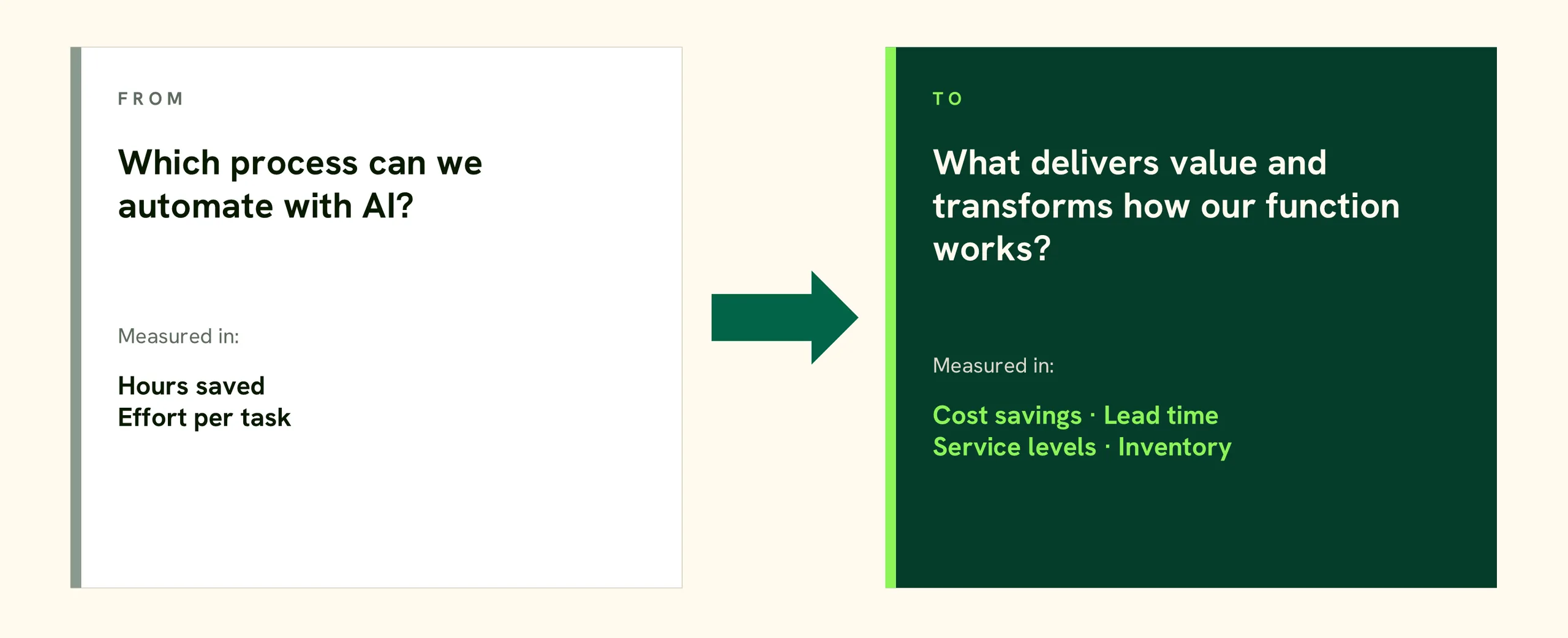
Task automation is usually justified by hours saved. That is easy to calculate and hard to bank: ten minutes saved across many people rarely turns into a lower cost base. It also starts the wrong conversation, one about effort per task and how many people a process needs.
Step-change use cases are justified by what the business actually measures: real cost savings, shorter lead times, better service levels, lower inventory and less leakage. Hours still count, but as the floor, not the headline.
The process we run
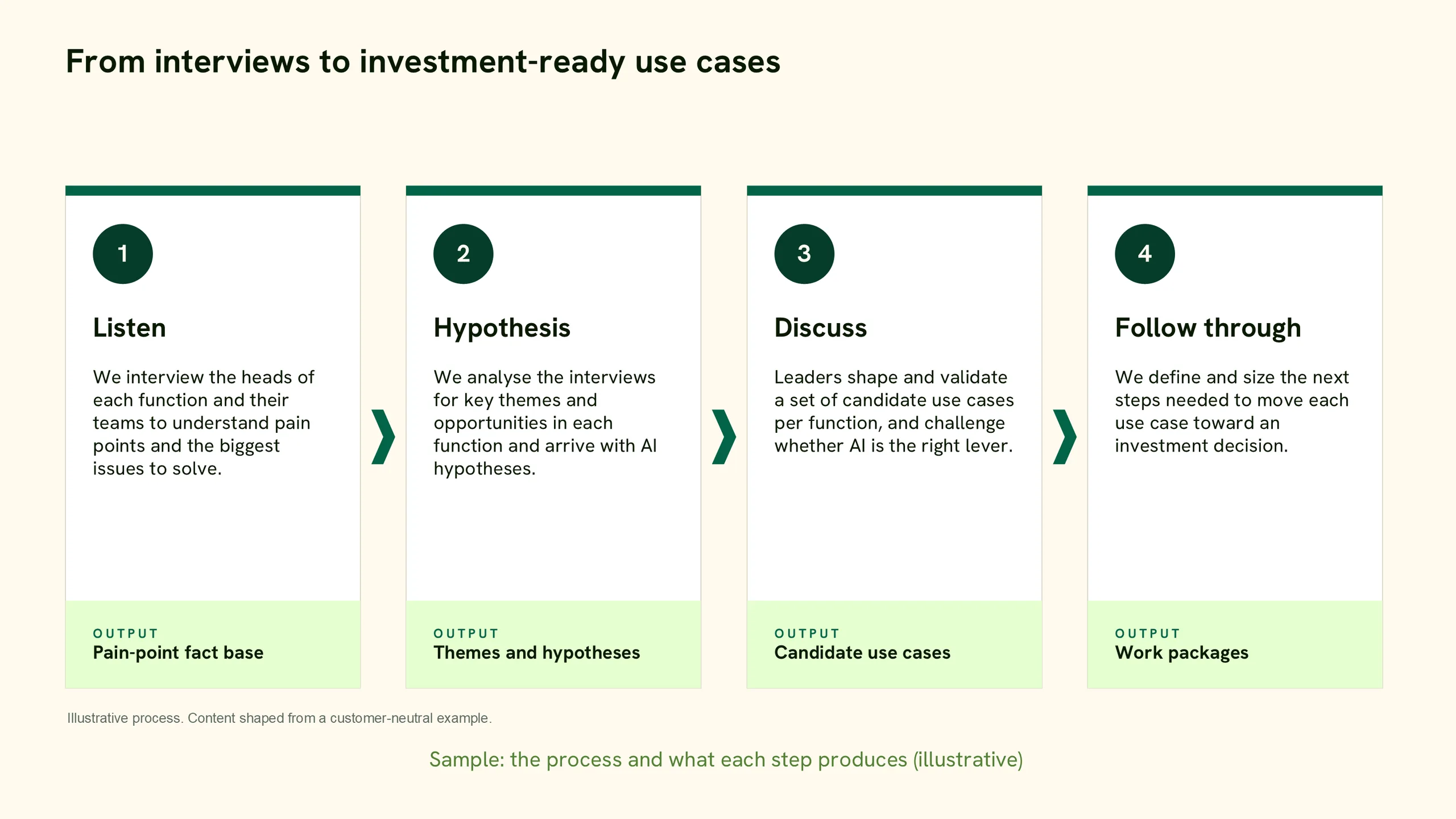
The way we get to step-change use cases matters as much as the use cases themselves. It has four steps.
Why the organisation follows along
Under every AI programme sits a quiet question: is AI replacing me? We do not pretend roles stay the same. We make the change visible and let the people who do the work shape it.
- They define the problem. The process starts with the leaders’ own pain points, not our solutions.
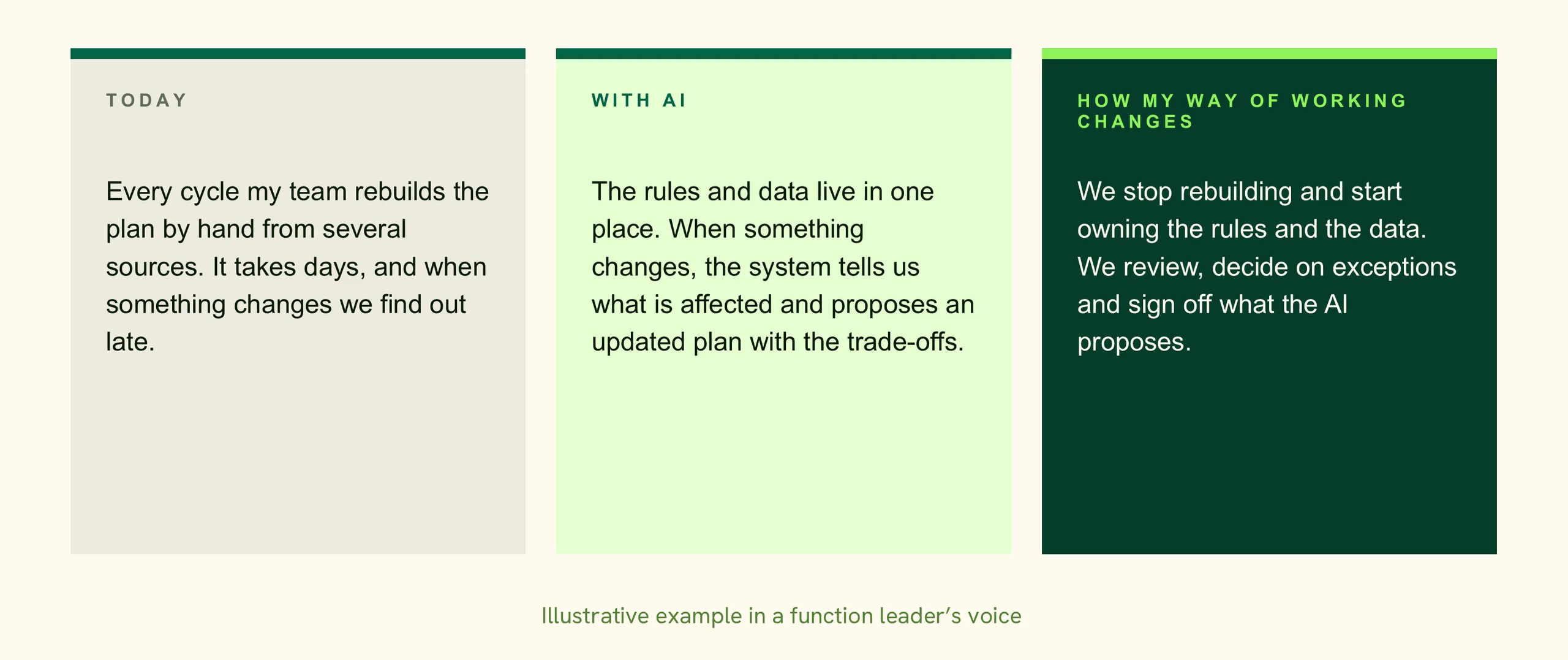
- The use case is in their words. Each one is written as today, with AI, and how my way of working changes.
- The way of working is the test. If the work is done the same way, it is task automation. A step change reshapes roles, processes and how the business sees the function: more judgement, more human creativity, less rework.
- They give the verdict. Keep, reshape or stop, including “AI is not the right lever here”.
The funnel – from many ideas to a few that are ready
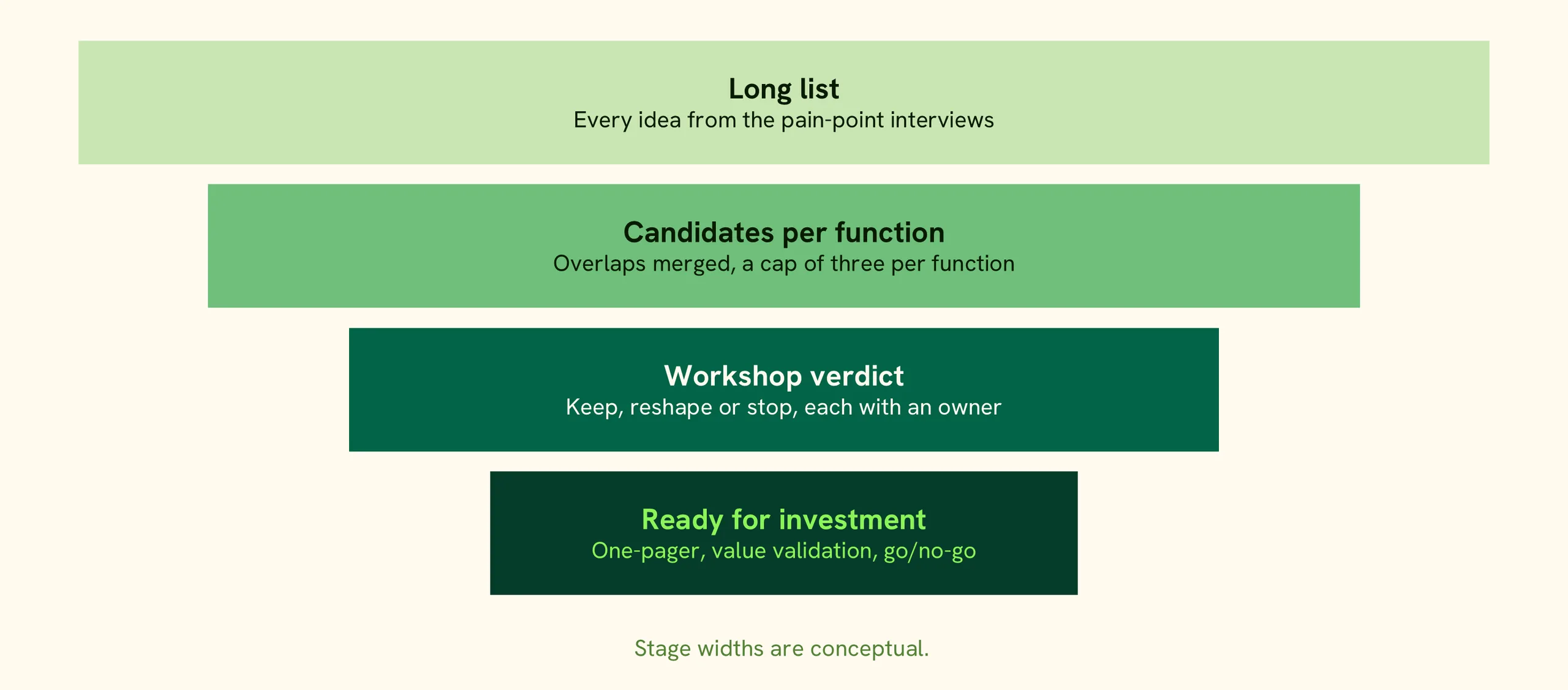
A long list of ideas narrows in four stages. Overlapping ideas are merged, and each function is capped at three candidates. The workshop gives every candidate a verdict. The ones that survive get a one-pager and a value validation that gives a go-or-no-go basis for a pilot.
What you end up with
- A vision or north star per function
- A one-pager per use case.
- A prioritised portfolio across functions.
- Defined next steps per use case: what needs to be done, not who does it.
- A value validation that gives a go-or-no-go basis for a pilot.
The one-pager is built to support a funding conversation. Samples and our template are below.
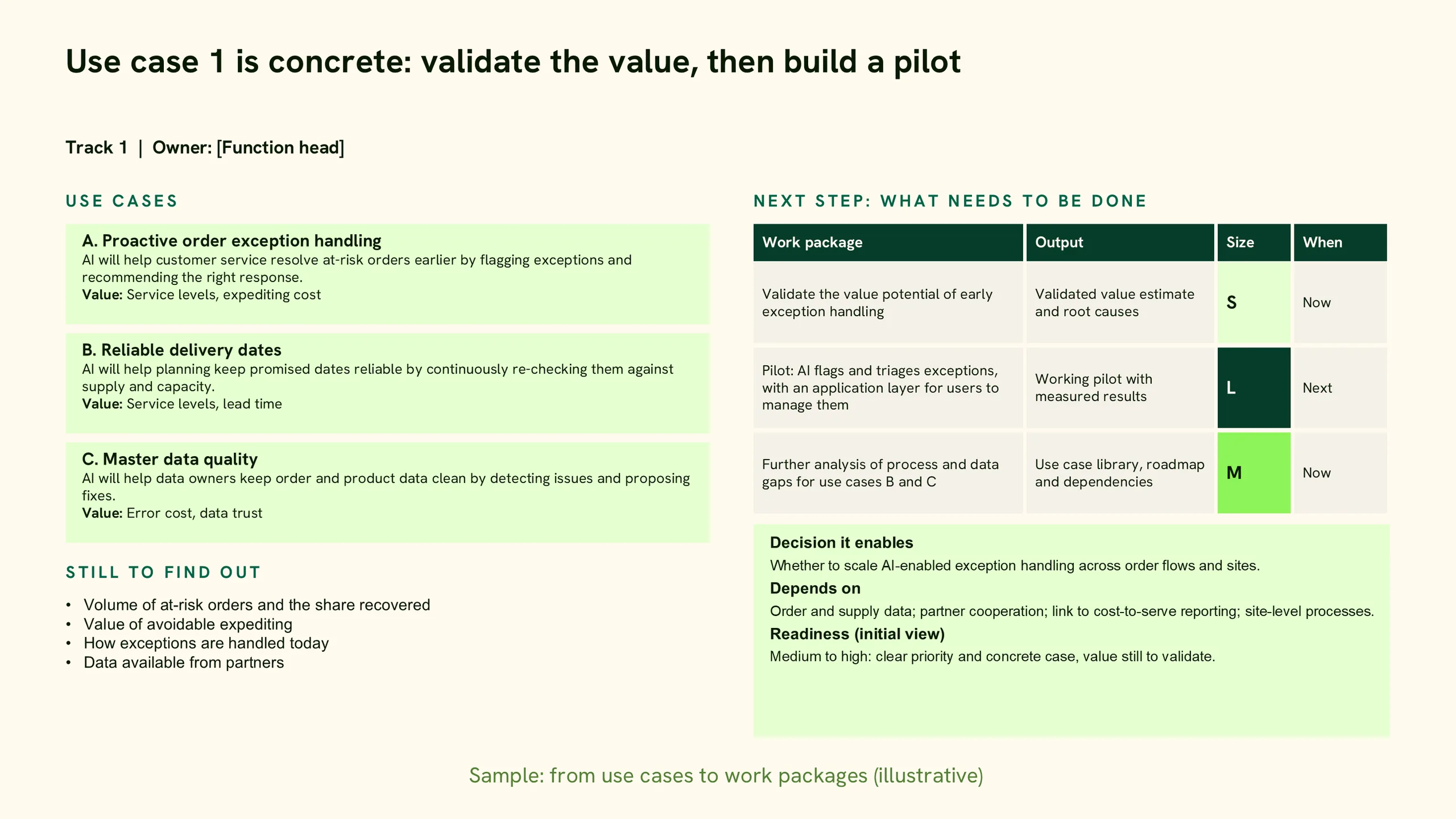
From use case to work packages
Each use case that survives the workshop is turned into concrete next steps: what needs to be done, what it produces, how big it is and when. That is what turns an idea into something a leadership team can fund.
Move to bin
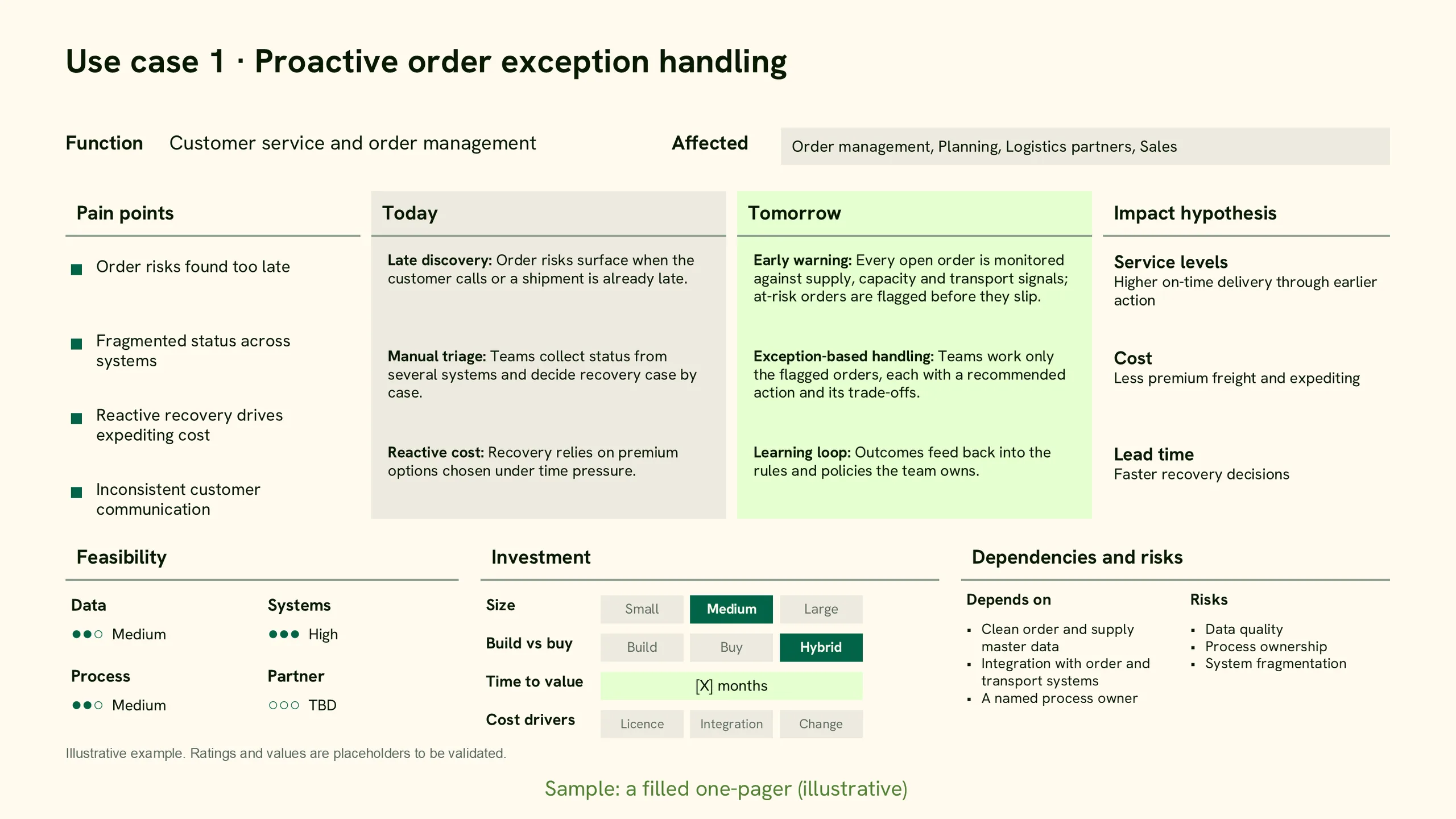
The one-pager
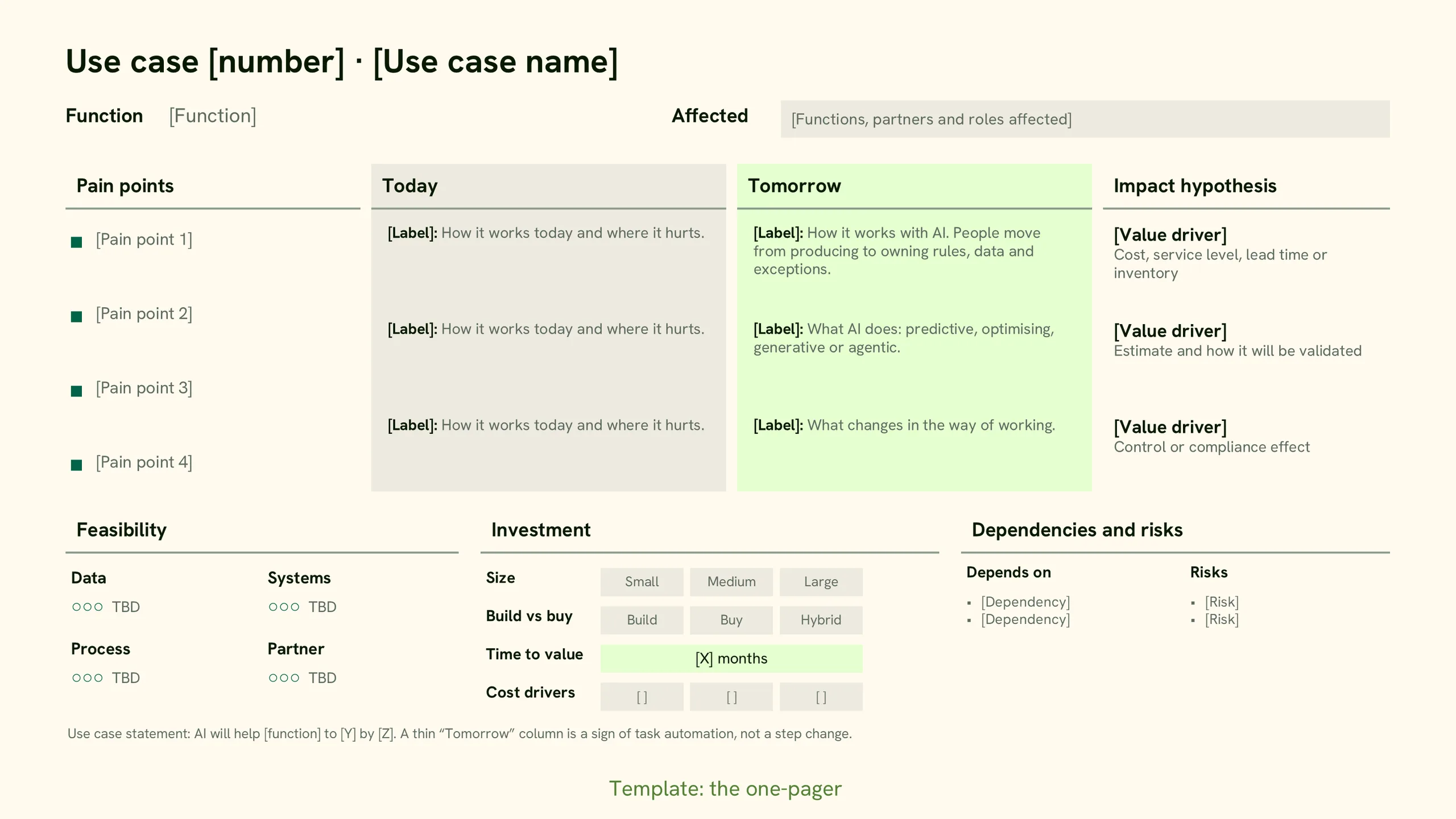
Every use case gets one page. It captures the function and who is affected, the pain points, how work looks today and tomorrow, the impact hypothesis, how feasible it is, what it would cost and what it depends on. A thin “Tomorrow” column is a sign of task automation, not a step change.
The blank template is below and is also available as an editable PowerPoint.
Find your step-change use cases
If your AI agenda is busy but your functions still work the way they did, we would be glad to talk.
We help leadership teams find and test the use cases that change how a function works, and we are honest when AI is not the answer.
Talk to us
Contact

Associate Partner | Consulting
Hadi Rizek
Associate Partner | Technology
Trine Kragelund